
Every Extinct Animal That’s Returning

A bird too giant for any egg on Earth, a wolf that split from dogs six million years ago, and a goat that is the only species in history to go extinct twice. Seven animals scientists are actively trying to bring back — and the strange machine each one requires.
The Paint Explainer walks through them in the video’s order, from New Zealand’s tallest bird to a single female ibex whose frozen cells started it all: what went extinct, why simple gene editing fails, and when — if ever — each one might return.
1. Giant Moa
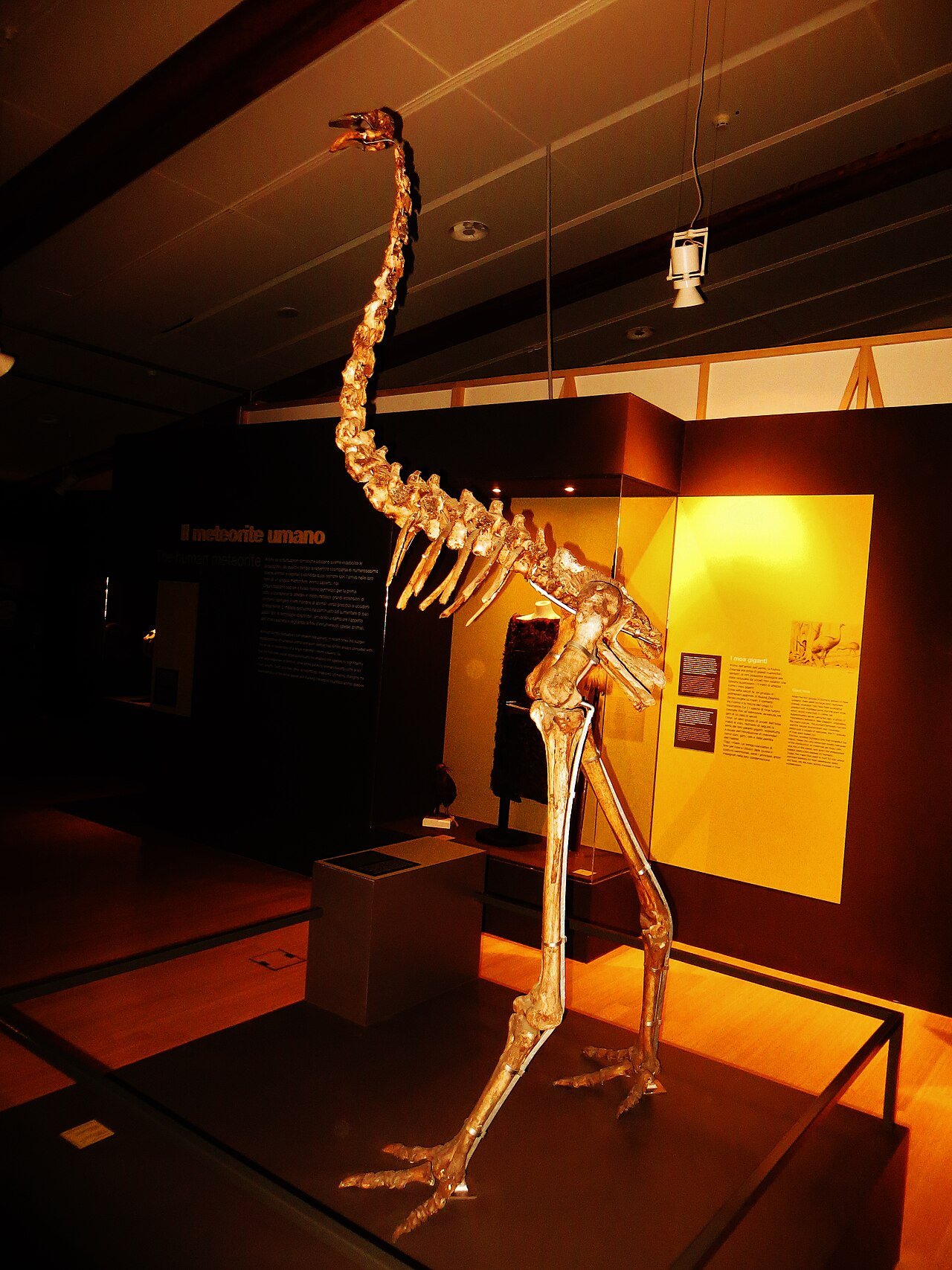
The Giant Moa is a huge bird that scientists want to bring back, and contrary to what you might think, the DNA isn’t even the hard part. Museums hold plenty of Moa tissue, so sequencing its genome is straightforward. The Moa was a massive flightless bird from New Zealand that stood close to 12 ft tall and weighed over 500 lb, hunted to extinction by humans around 600 years ago.
The problem is the egg. The plan for most de-extinction is to edit a living relative’s cells so its eggs carry the extinct animal instead — but a Moa egg is estimated at 80 times the size of a chicken egg and eight times an emu egg. No bird alive is large enough to sit on one, or to lay one.
- The workaround: start a Moa embryo inside a living bird’s egg, probably an emu, then move it within 24–48 hours into an artificial egg built as big as the embryo will eventually get.
- Progress: scientists already built a working artificial egg and hatched over two dozen chickens in it. The next step is scaling the same system up to Moa size.
No date has been given for a first Moa chick — unlike the animals further down this list.
2. Tasmanian Tiger

The Tasmanian tiger needs something stranger than lab-grown eggs or edited cells: an artificial organ that doesn’t exist yet. It was a striped, dog-sized marsupial that once lived across Australia and Tasmania. It looked enough like a wolf that people assumed it was related to one, but it was actually closer to kangaroos. Hunted as a threat to livestock, the last known one died in a Hobart zoo in 1936.
Scientists are rebuilding its genome using its closest living relative, a mouse-sized marsupial called the fat-tailed Dunnart. The real challenge is what happens after editing: a Tasmanian tiger baby was born after only a few weeks, blind and the size of a grain of rice, then crawled into its mother’s pouch to keep developing on the outside for months.
- Why that helps: the tiny starting size means a Dunnart could plausibly carry and give birth to one.
- Why it isn’t enough: a real Dunnart’s pouch is built for a Dunnart-sized baby, not a tiger that keeps growing for months and needs far more space and milk than a Dunnart mother can provide.
So scientists are building an artificial pouch that takes over once the baby outgrows its birth mother, complete with a custom milk formula that changes as the baby develops. Half of this animal’s development would happen inside a machine. The project has run since 2022 on a 10-year timeline; an artificial womb has already carried embryos partway through development, and nobody has produced a living Tasmanian tiger yet.
3. Dodo
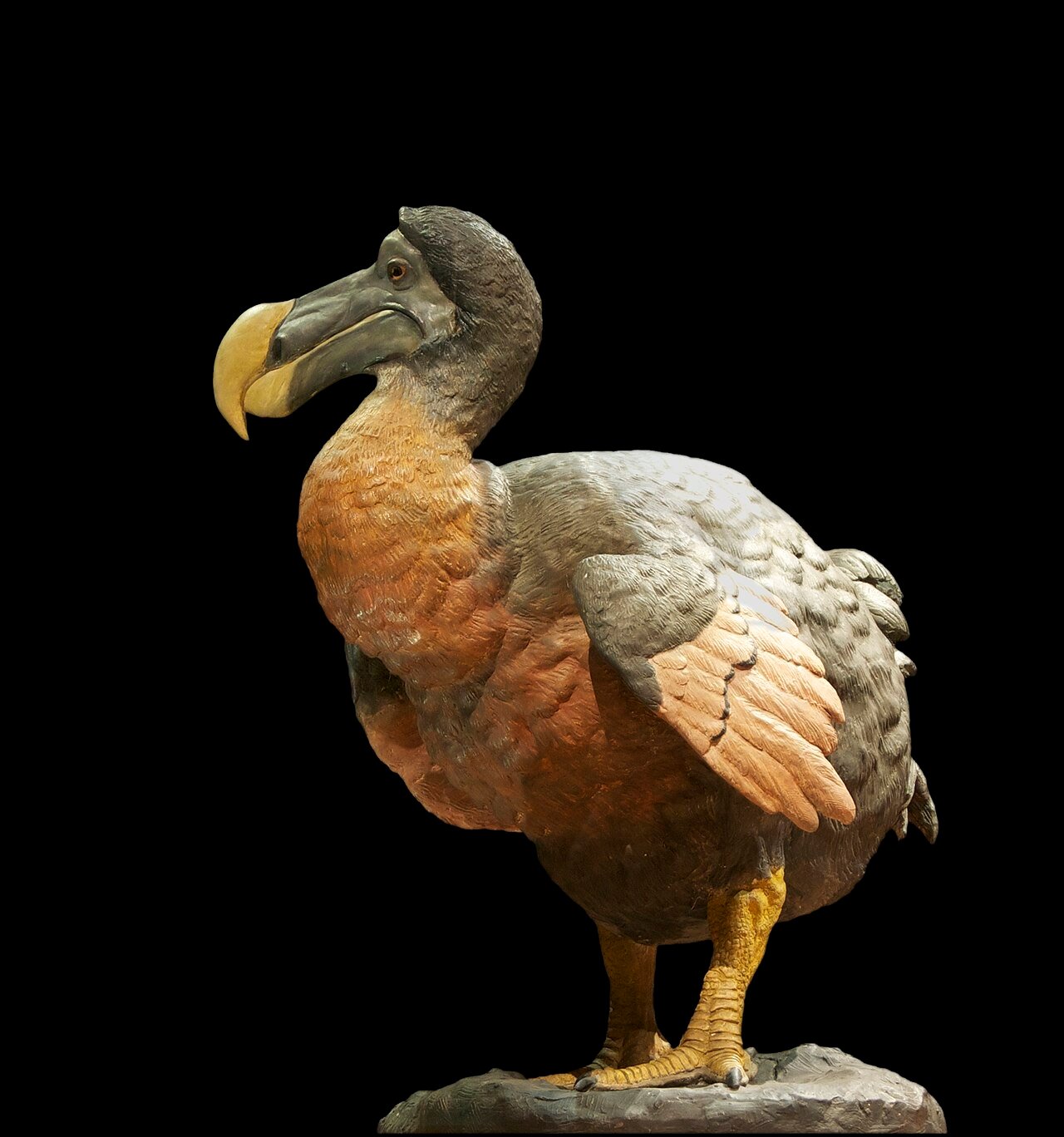
The Moa’s problem was size. The Dodo’s problem begins before the bird is even born. A slow, funny-looking flightless bird about 3 ft tall, it lived only on Mauritius. When Dutch sailors arrived in 1598 they brought rats, pigs, and macaques that ate its eggs — and having never seen a predator, the Dodo had no instinct to flee. Within about 100 years it was gone.
Cloning mammals works because a mammal egg is a single grown cell: swap the DNA, let it grow. A bird egg doesn’t offer that. The yolk is the egg cell, fertilized inside the mother long before any shell forms, and by the time the egg is laid the embryo has already divided into something like 50,000 cells. There is no single cell left to edit.
- The entry point: the primordial germ cell — a cell that hasn’t decided what it will become yet and will eventually turn into egg or sperm.
- The trick: take cells from the Nicobar pigeon (the dodo’s closest living relative), edit in dodo genes, inject them into a chicken embryo. The hatched chicken looks normal, but its reproductive organs produce dodo genetics. Breed two of those together and the egg hatches a dodo.
Pigeon primordial germ cells have been grown successfully for the first time ever, chickens with their germ cells removed already exist, and a Nicobar pigeon breeding colony has started. There’s even a committee in Mauritius planning how a returned dodo would be released. The company’s CEO estimates five to seven years for the first dodo to come back.
4. Passenger Pigeon

It’s insane how this pigeon went extinct. There were likely billions of them in North America, flying in flocks so massive eyewitnesses said they blocked out the sun for hours. Hunted hard and fast, the species collapsed within decades; the last one, Martha, died alone in a Cincinnati zoo in 1914.
Passenger pigeons face the same germ-cell problem as the dodo, plus one of their own: they didn’t just live in enormous flocks, they needed the flock to work. Breeding and even foraging seem to have depended on being that numerous.
- The real goal isn’t hatching one bird — it’s building a population large enough for the flock instinct to kick back in.
- Timeline: the project has run since 2012, longer than any other on this list; the full genome is already sequenced from museum specimens, and the target to hatch the first proxy passenger pigeon is the early 2030s.
5. Woolly Mammoth

Arguably the most interesting one so far — and the first animal on this list whose failure mode risks a living endangered animal every time something goes wrong. The mammoth died out around 4,000 years ago; its closest living relative, the Asian elephant, shares about 99.6% of its DNA. The leftover 0.4% is what gave it the shaggy coat, thick fat layer, and cold tolerance.
As a test run, scientists already gave mice mammoth-style genes for fur and fat, and it worked. But the elephant that would carry a mammoth embryo is endangered, so the company has looked at larger African elephants as surrogates — except Asian elephants are actually the closer relative, which flips that advantage on its head. And elephant pregnancies last around 22 months, the longest wait on this list: if something goes wrong deep into a live pregnancy, there is no quick fix and no fast retry.
- That’s why the company has stated it doesn’t want living elephants as surrogates at scale, and is developing artificial womb technology to grow the pregnancy outside an elephant’s body entirely.
- The catch: no artificial womb has ever supported an animal anywhere near the size of a newborn mammoth, which weighs around 250 lb at birth. Until that’s solved, the first mammoth pregnancies will still run through living elephants.
The craziest part: the estimated return date is 2028.
6. Dire Wolf

Every animal so far is something scientists are still working toward. The dire wolf is different, and it’s the subject of one of the most heated debates in the field. For most of history everyone assumed dire wolves were just bigger gray wolves — then a 2021 genetic study blew that apart: the two split around 6 million years ago and evolved separately ever since. Genetically, a dire wolf is closer to a jackal than to the wolf beside it in old textbook illustrations.
Dire wolf DNA turned out to be about 99.5% identical to a gray wolf’s, but that leftover half percent is still millions of individual differences — a scale of editing nobody could realistically finish. So the company did something unique: using ancient DNA from a 13,000-year-old tooth and a 72,000-year-old ear bone found in Idaho, it compared genomes and picked just 20 differences across 14 genes — the ones tied to size, a wider skull, bigger teeth, and a pale coat.
- Those 20 edits went into gray wolf cells, which were cloned and carried by dog surrogates. In October 2024 and January 2025, three pups were born: Romulus, Remus, and Khaleesi.
- The argument: the company calls them the world’s first successfully de-extincted animals. Many geneticists disagree — 20 edited genes out of millions of differences doesn’t reconstruct a dire wolf, it gives a gray wolf a dire wolf’s appearance.
All three live together in a pack on a 2,000-acre secured sanctuary, but staff still provision their food, so it’s not a self-sufficient wild pack. Whether that makes them dire wolves or convincing stand-ins depends on who you ask.
7. Pyrenean Ibex
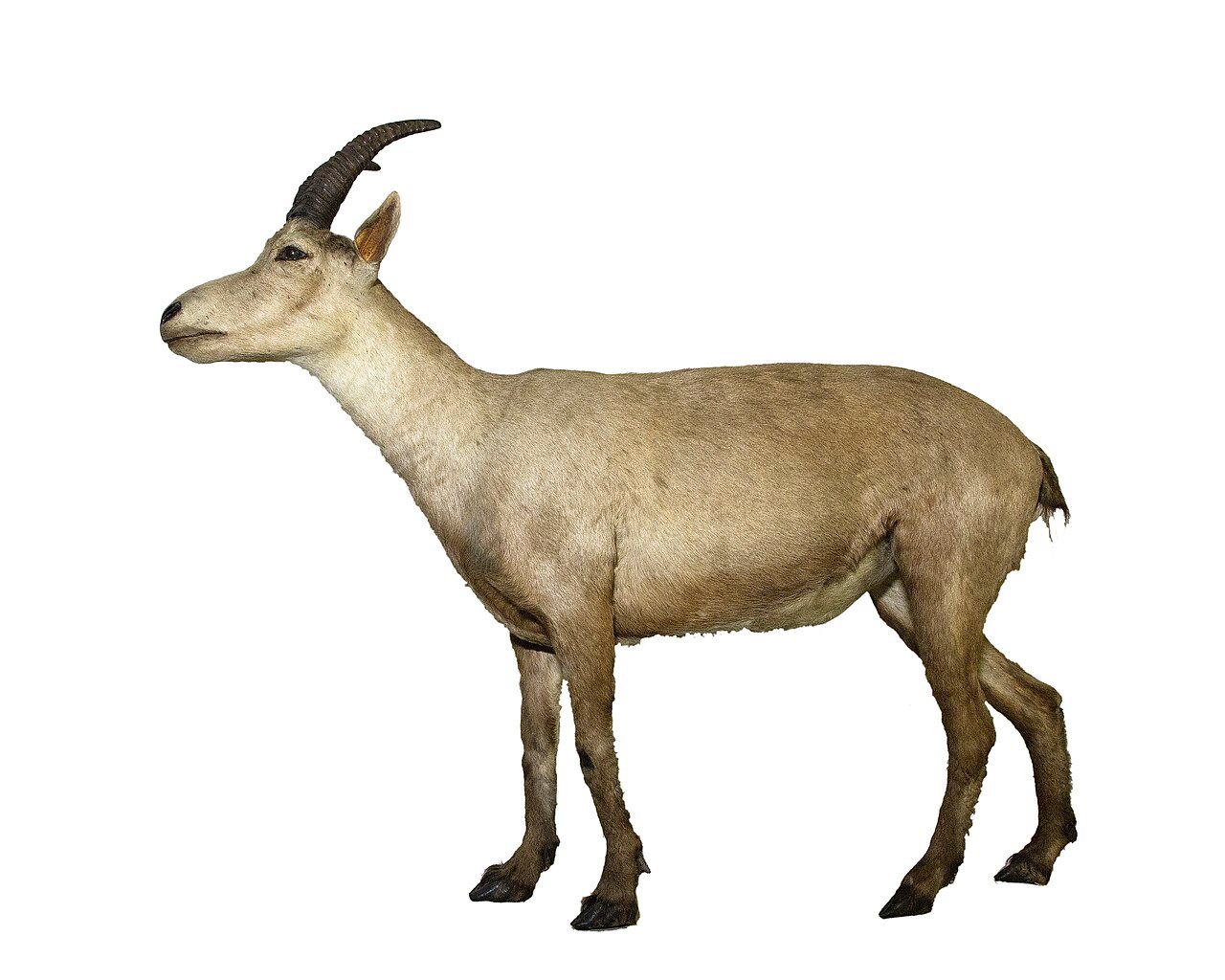
This is the one case where nobody has to argue, because de-extinction was tried all the way to the end — over 20 years ago. The Pyrenean ibex was a wild mountain goat hunted for centuries until only a handful remained in a single national park in Spain. By 1999 exactly one was left: a female named Celia. Scientists took a small tissue sample from her ear and froze it. On January 6, 2000, Celia was killed by a falling tree branch, making the species officially extinct.
Three years later, in 2003, a team of Spanish and French scientists thawed those cells and gave de-extinction its first real attempt: the nucleus from Celia’s preserved cells went into goat eggs emptied of their own genetic material, and over 200 embryos were implanted into surrogate mothers.
- Almost all failed. A handful became pregnancies; nearly every one ended in miscarriage.
- One didn’t. On July 30, 2003, a surrogate gave birth to a cloned Pyrenean ibex — for a few minutes, an animal that no longer existed anywhere on Earth was alive again.
Then her breathing failed and she died about 10 minutes after birth. An autopsy found a malformed lung, a defect common in cloned animals. The Pyrenean ibex became extinct for a second time — the only species in recorded history to hold that record.
| Animal | Where it stands | Earliest return |
|---|---|---|
| Giant Moa | Artificial egg scaled up from chickens | No date given |
| Tasmanian Tiger | Artificial pouch + milk in development | 10-year plan from 2022 |
| Dodo | Germline editing in chickens | 5–7 years |
| Passenger Pigeon | Proxy bird + flock retraining | Early 2030s |
| Woolly Mammoth | Surrogate or artificial womb | 2028 |
| Dire Wolf | Three pups already born | 2024–2025 (debated) |
| Pyrenean Ibex | Born 2003, died 10 minutes later | Only full attempt so far |
What Comes Next?
Seven animals, seven completely different bottlenecks: no bird big enough for an egg, no pouch that fits, no single cell left to edit, no flock to teach, no womb that fits a 250 lb calf, millions of edits nobody can finish, and one goat that didn’t survive ten minutes. The pattern is clear — reading the genome was the easy part. Everything that goes wrong happens after that.
The next few years will settle a lot of it. The mammoth’s 2028 target and the dodo’s five-to-seven-year estimate are close enough to check, the passenger pigeon’s early-2030s proxy is already in motion, and the three dire wolves keep growing while geneticists argue over what to call them. If the ibex proved anything, it’s that the last ten minutes are the hardest part — and that’s exactly what everyone is now trying to engineer away.
Image Credits
- Ice age fauna of northern Spain – Mauricio Antón by Mauricio Antón — CC BY 2.5
- Dinornis giganteus MUSE by Ghedoghedo — CC BY-SA 4.0
- Thylacinus cynocephalus at Hobart Zoo 1928 by Harry Burrell — Public domain
- Dronte dodo Raphus cucullatus by Jebulon — CC0
- Ectopistes migratorius (passenger pigeon) 4 by James St. John — CC BY 2.0
- Mammuthus primigenius fraasi by Ghedoghedo — CC BY-SA 3.0
- Dire Wolf (Canis dirus) skulls at the Page Museum at the La Brea Tar Pits (6802031936) by Dallas Krentzel — CC BY 2.0
- Capra pyrenaica pyrenaica MHNT ART 39 by Roger Culos — CC BY-SA 4.0