
The Most Disturbing Paleontological Discoveries Ever

Some fossils sit quietly in a museum case. These twelve did the opposite — they broke the classification systems built to hold them. A creature nobody can call vertebrate or invertebrate after 60+ years of study. A spiral of teeth with no skull, no jaw, no body, and a question that took a century to answer.
The Paint Explainer works through twelve of the strangest paleontological discoveries ever made, from a shop-bought molar that rewrote the record on giant apes to a 1 mm wrinkled bag of an animal that may have had no back end at all.
1. Tully Monster
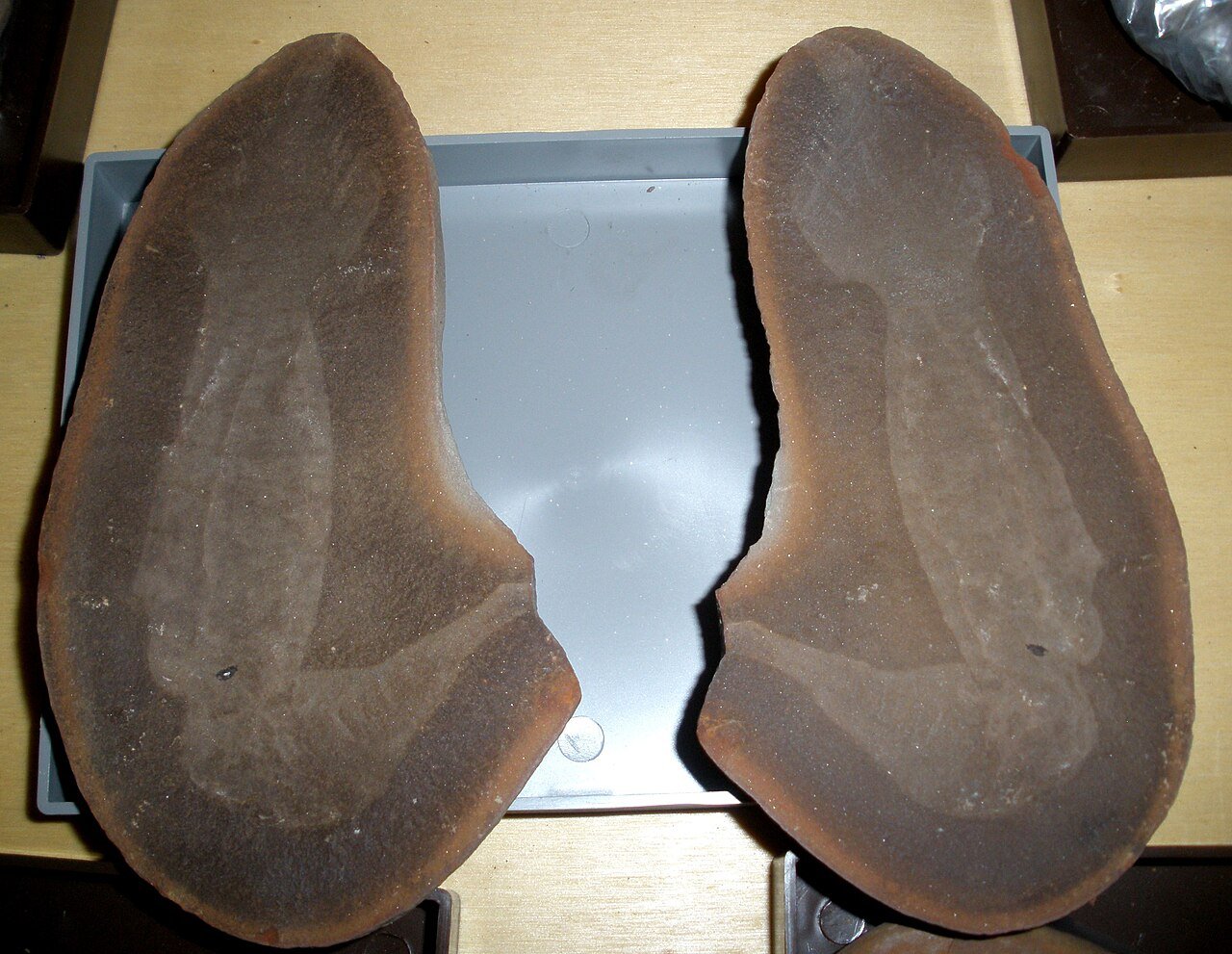
Discovered in 1955 by Francis Tully, an amateur fossil hunter digging through Illinois deposits, and brought to the Field Museum in Chicago — where scientists could not place it in any known category of animal.
- Not sure if it was a vertebrate or an invertebrate. Not sure what group it belonged to. Not sure how it was related to anything else alive at the time.
- The body plan: soft and elongated, tail fin at one end, a long flexible snout with a small claw-like toothed mouth at the other — and eyes sitting on rigid stalks extending sideways from its body, resembling nothing alive today.
- Age: about 307 million years ago. Illinois made it the official state fossil in 1989.
- Still open: what it ate, how it moved, and where it fits in the history of life remain genuinely unanswered.
2. Gigantopithecus
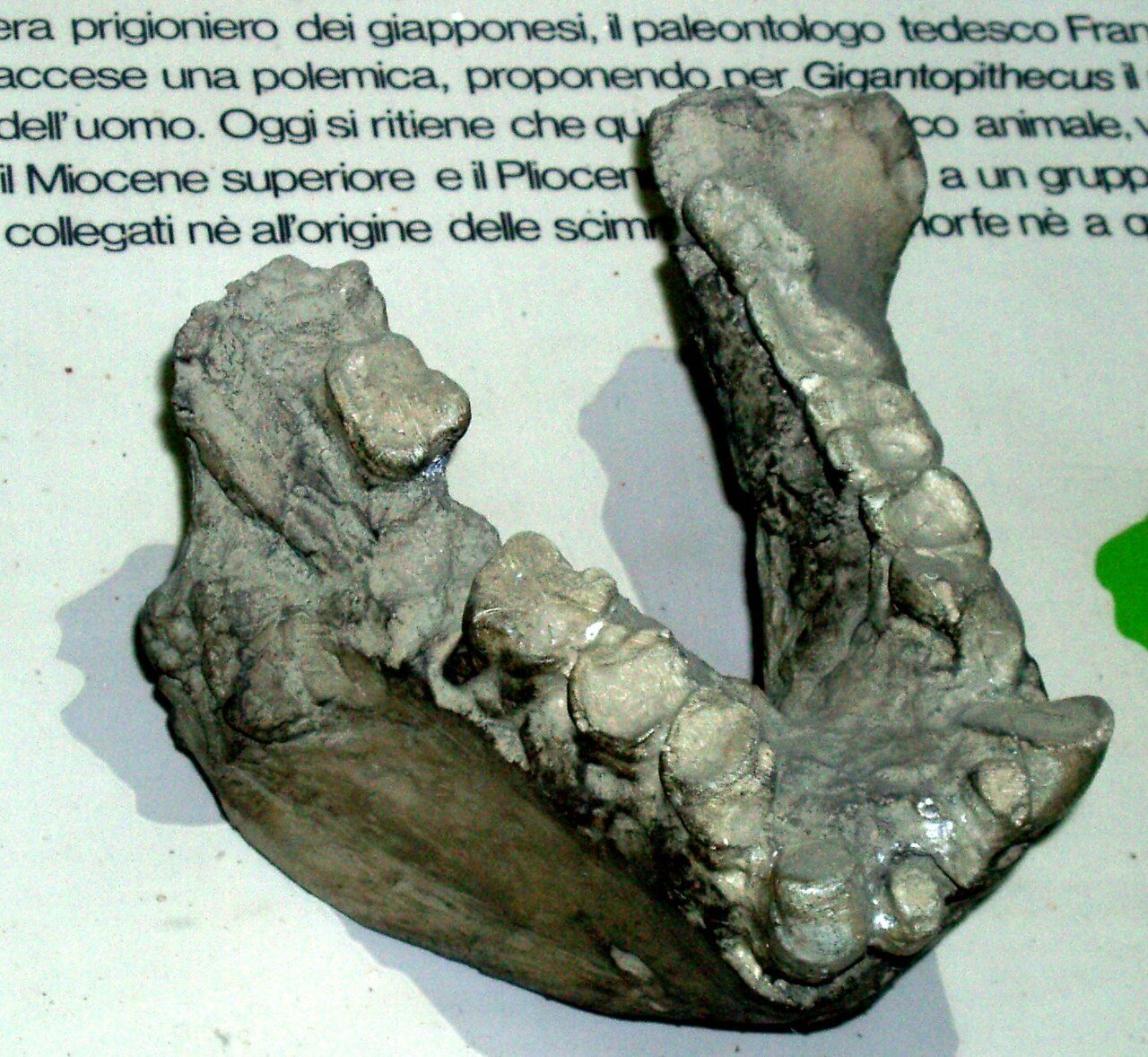
It wasn’t found at a dig site. It was found in a shop. In 1935, a paleontologist browsing an apothecary in Hong Kong — where fossilized bones and teeth were sold as “dragon teeth” for traditional medicine — picked out a single molar that was unmistakably primate, and unbelievably huge.
- The conclusion: it came from an ape significantly larger than any known species. Decades of searching across southern China and Southeast Asia yielded more material — but the entire known collection amounts to a handful of jaw bones and around 2,000 isolated teeth. No skull, no limb bones, no spine.
- The estimates: around 10 ft tall, up to 660 lb — the largest ape ever known to have existed, moving on all fours like a gorilla rather than upright.
- The eerie part: it survived until roughly 250,000 to 300,000 years ago, when Homo erectus occupied the same regions. The two almost certainly met.
- Extinction: a 2024 study identified climate shifts that eliminated the food sources it depended on.
3. Kelenken

In 1999 in Argentina, an amateur fossil hunter named Guillermo Aguirre found the largest bird skull ever — living or extinct. Examination identified it as Kelenken, a terror bird: part of a family of large flightless predators that dominated South America for millions of years.
- Stats: roughly 15 million years ago, standing around 10 ft tall — the largest terror bird ever discovered, capable of about 37 mph.
- The hunting method: it almost certainly couldn’t swallow large prey whole. It ran prey down at speed, then used its beak like a hatchet — striking downward repeatedly, or grabbing smaller animals and slamming them against the ground.
- Why it thrived: South America was isolated for much of this period, so terror birds had little competition. When North and South America connected, new predators moved south, ecosystems changed, and Kelenken disappeared.
4. Helicoprion

In the 1890s, deep in Russia’s Ural Mountains, a researcher found a tight spiral of teeth, perfectly preserved — almost like a circular saw blade made of bone. The problem: no jaw around it, no skull, no body. Just the spiral.
- The 100-year question: where on Earth did a circular saw blade fit on a fish? Theories came and went for a century. A 1950 find in an Idaho phosphate mine preserved bits of jaw cartilage alongside the teeth.
- Solved in 2013: a CT scan of that Idaho specimen revealed the spiral sat entirely enclosed within the lower jaw — a biological meat slicer inside the mouth. Bite down, and it rotated, pulling prey inward and slicing as it went.
- Size: largest recognized specimens reached roughly 25 to 32 ft long.
- The detail that earns its place on this list: old teeth never fell out. They kept spiraling inward, tightly wound, forever — every tooth it ever grew from birth was still inside its jaw at death.
- Fate: wiped out in the Permian-Triassic extinction, which killed about 90% of all marine species.
5. Arthropleura
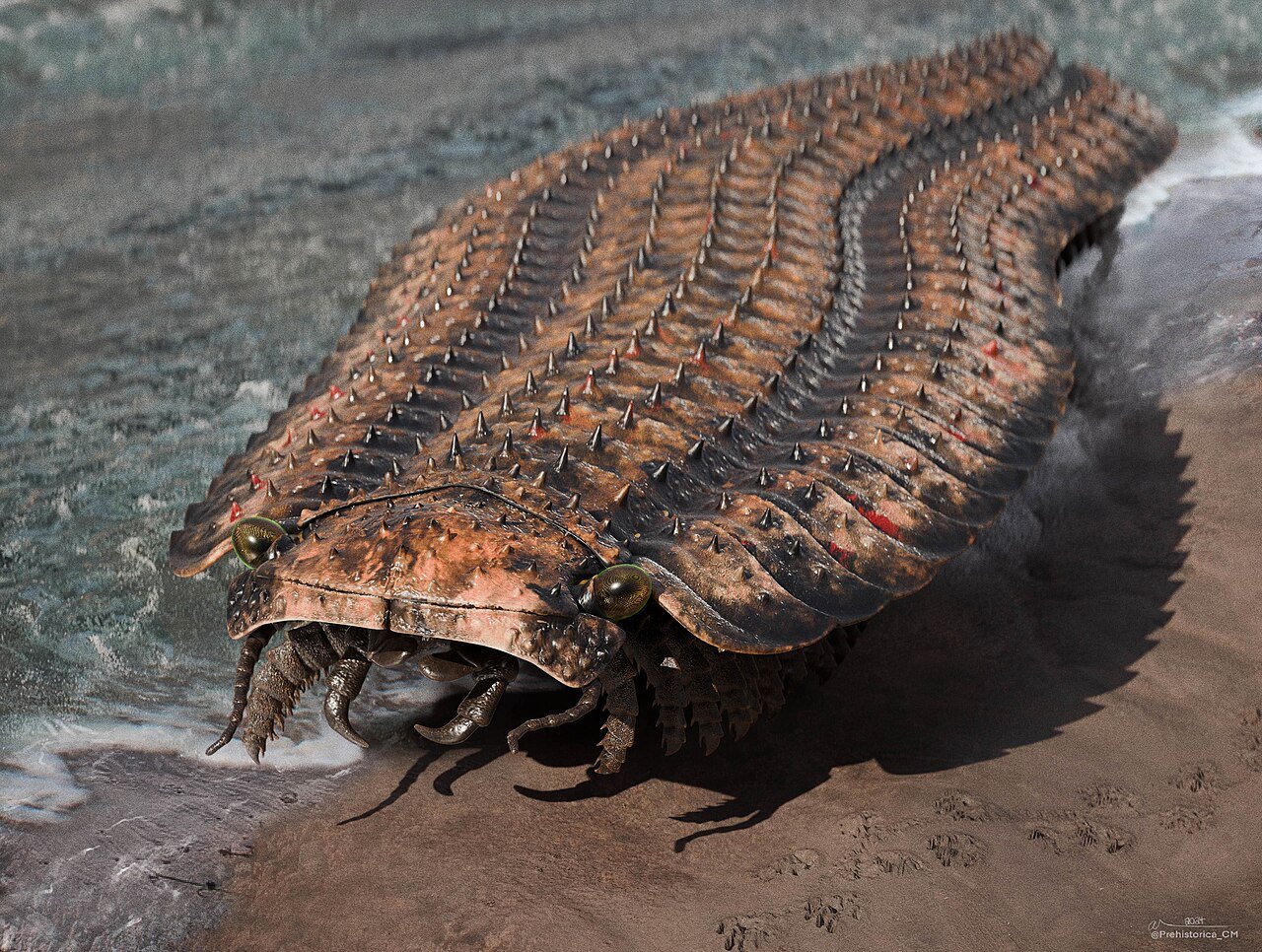
Imagine something as big as a car, covered in armored plates, dozens of legs moving steadily toward you. Arthropleura, the giant millipede: up to 8 ft long and 1.5 ft wide, the largest land invertebrate we have evidence of, living around 300 million years ago.
- The tracks: fossilized footprints over 20 in wide — big enough that if you stumbled on them today you’d mistake them for ATV tire tracks.
- The 170-year mystery: its head. Most fossils were empty exoskeletons left behind after molting, so nobody knew what its face looked like.
- Revealed by CT scans of rare young fossils: a millipede body with the jaws of a centipede and stalked eyes like a crab — stalks that suggest it may have been semi-aquatic.
- Life & death: it moved through leaf litter on forest floors eating rotting plants and fungi, until competitors surpassed it and the climate dried out, shrinking its habitat to nothing.
6. Jaekelopterus
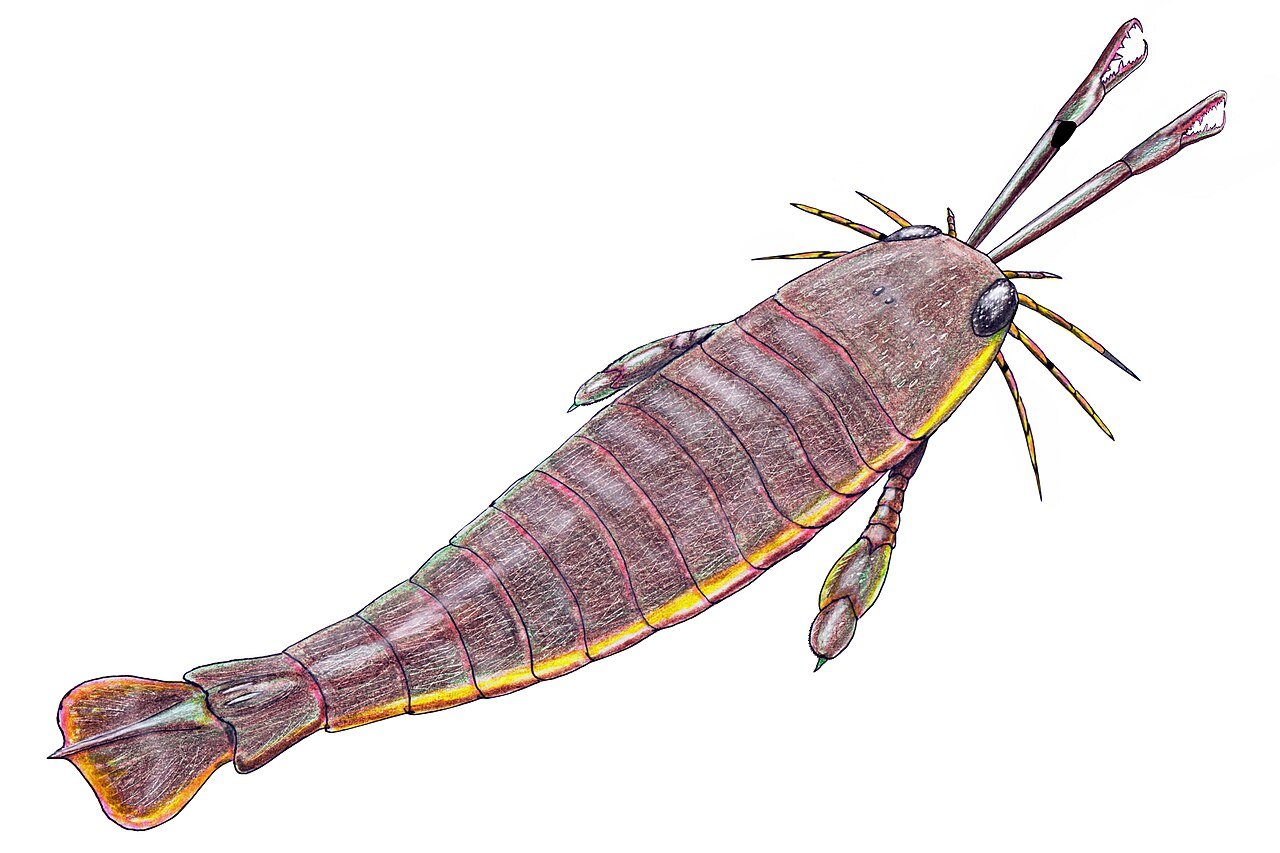
Walking into a murky river with water up to your knees — then two spiked claws close in from below, each roughly the length of a grown man’s arm.
- The find: Germany, 2007 — a single claw, 18 inches long. From that one piece, researchers estimated the full animal at around 8 ft in length: the largest arthropod ever discovered (the group that includes insects, spiders and crustaceans).
- When & where: roughly 390 million years ago, in rivers and estuaries — the saltier water where rivers meet the sea.
- The claws weren’t for defense. It was a predator that likely waited in shallow, muddy water and ambushed anything that came too close — nearly invisible until it was too late.
- Fate: changing conditions and competing predators.
7. Dunkleosteus
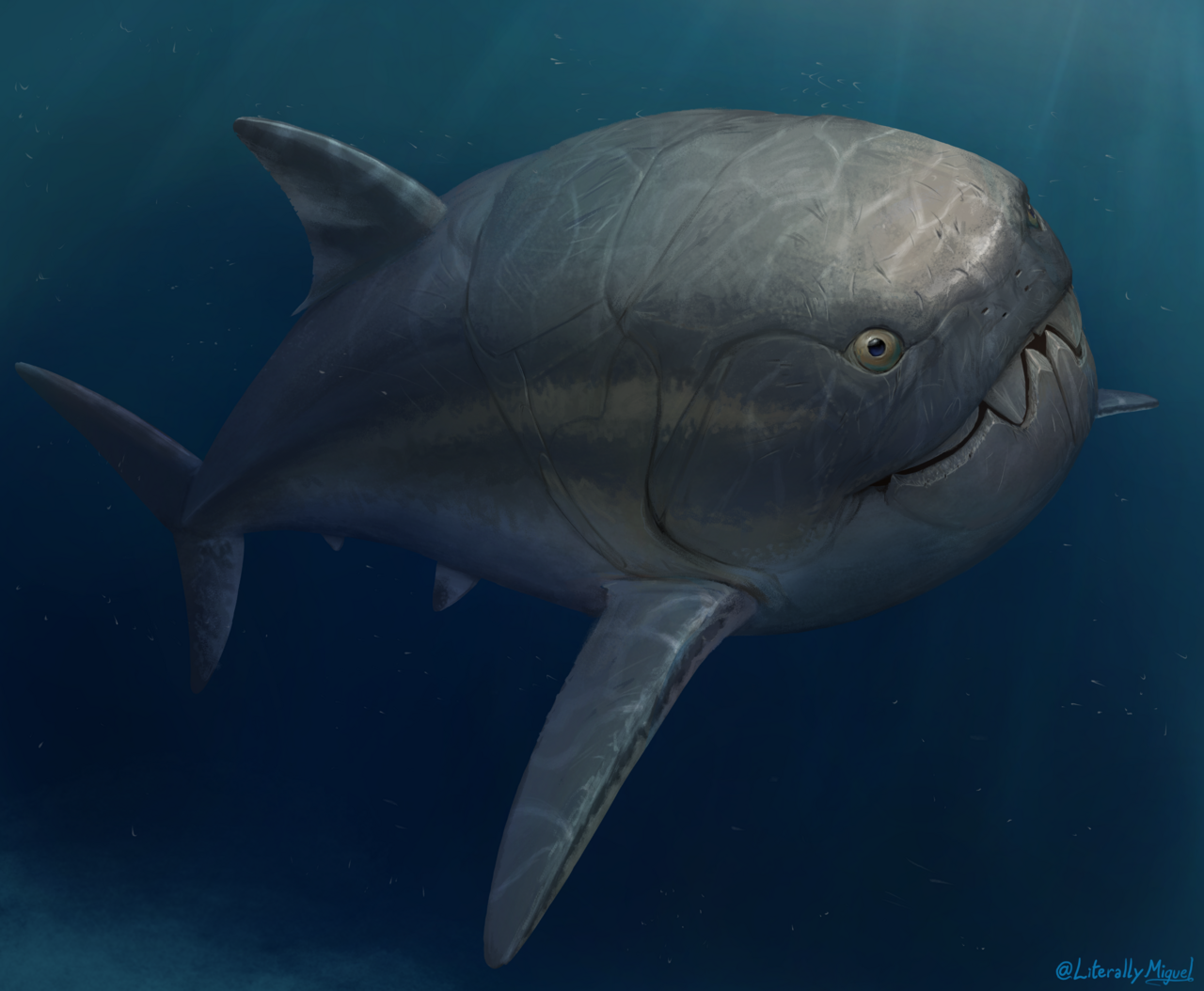
Usually, to eat, animals have teeth. Dunkleosteus didn’t. Its head was armored with bony plates that extended into its mouth, forming two pairs of sharp-edged blades that worked like scissors — grinding against each other and re-sharpening with every strike. A guillotine instead of teeth.
- Bite force: estimated between 6,000 and 7,500 Newtons at the tip, placing it among the most powerful bites of any animal ever measured.
- Speed of the strike: jaws opened in about 1/50 of a second, generating suction that pulled prey directly into the mouth before it could react.
- Size: between 11 and 13 ft long, hunting the shallow seas that covered much of what is now North America and Europe about 382 million years ago.
- The disturbing addendum: fossil deposits contain regurgitated remains of other Dunkleosteus. It ate its own kind, then brought up the parts it couldn’t digest. It was also a cannibal.
- Fate: the Late Devonian extinction, one of the five major mass extinctions.
8. Titanoboa

In 2009, in an open coal mine in northern Colombia, workers and researchers had been pulling odd fragments out of the ground for a while — a lot of them ended up in boxes. Then a snake specialist looked closely at one piece and everything changed: it was unmistakably snake bone, just far too large to make any sense.
- When: around 58 to 60 million years ago, right after the dinosaurs went extinct.
- How it killed: a constrictor — wrapping and squeezing, the same way anacondas and pythons do today.
- The size: roughly 42 ft long and over 2,200 lb. The largest anacondas alive today barely reach 26 ft and weigh a fraction of that.
9. Hallucigenia

The name resembles “hallucination” on purpose: this is one of the most confusing creatures in paleontology. When it was first reconstructed in 1977, scientists built it upside down and back to front. Found in Canada and dated to the Cambrian explosion, about 508 million years ago.
- The inversion: the first reconstruction had it walking on a row of rigid spines like stilts, with soft tentacles waving from its back. The “legs” were actually protective spines along its back; the “tentacles” were actually its soft, clawed legs underneath.
- The fake head: a dark rounded blob at one end of many fossils was long assumed to be the head. A 2015 study confirmed it was just a stain from fluid that seeped out during decomposition. The real head was on the opposite end.
- The mouth: small and round with simple eyes, a circular mouth containing a ring of teeth — plus additional teeth running down the throat pointing inward, so anything entering could not be pulled back out.
- The lineage: the same study placed it on the branch leading to velvet worms, within the group that includes all molting animals — insects, spiders, crustaceans and many more.
10. Megalania

The closest thing we have to a real-life venomous dragon — and it lived recently enough that humans likely saw it. A giant monitor lizard in Australia until roughly 40,000 to 50,000 years ago, when woolly mammoths were still alive and the first humans had already reached the continent. A face-to-face meeting is a real possibility.
- Size: somewhere between 11.5 and 23 ft long, the largest terrestrial lizard known to have existed — significantly larger than today’s Komodo dragons, to which it was closely related.
- Method: likely an ambush predator that rushed prey suddenly, with a real possibility it produced venom just like Komodo dragons.
- Prey: the large mammals of prehistoric Australia, including giant wombat-like creatures the size of hippos.
- Fate: as those prey populations declined — possibly from human hunting pressure and climate shifts — Megalania ran out of food.
11. Saccorhytus
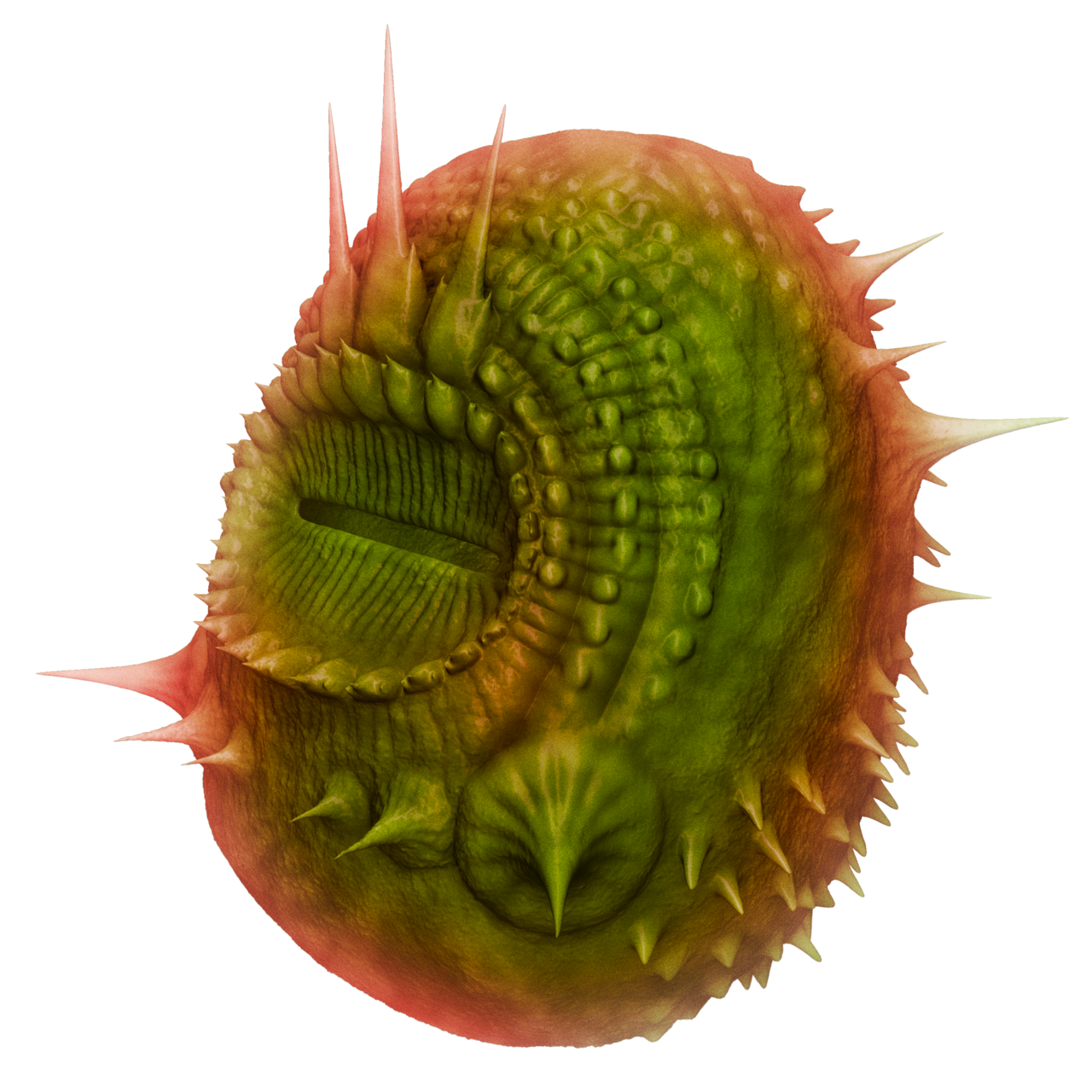
Disturbing for a different reason — possibly the nastiest one on the list. Found in Chinese limestone deposits dating back roughly 540 million years to the Cambrian, the fossils were about 1 mm across, extracted from rock under microscopes.
- The creature: small, wrinkled and bag-shaped, with an enormous mouth relative to its body — the name roughly translates as “wrinkled bag.”
- The problem: it appeared to have no anus. Researchers suggested waste was likely expelled back out through the mouth.
- The stakes of its family tree: when described in 2017, the team proposed it was one of the earliest known deuterostomes — the branch that eventually produced fish, amphibians, reptiles, birds, mammals and humans. If correct, it sat very close to the base of the tree that produced us.
- The correction: a later study debunked that, repositioning it as a very early, primitive ancestor of arthropods and nematodes — the group containing insects, crabs, spiders and roundworms.
12. Tanystropheus
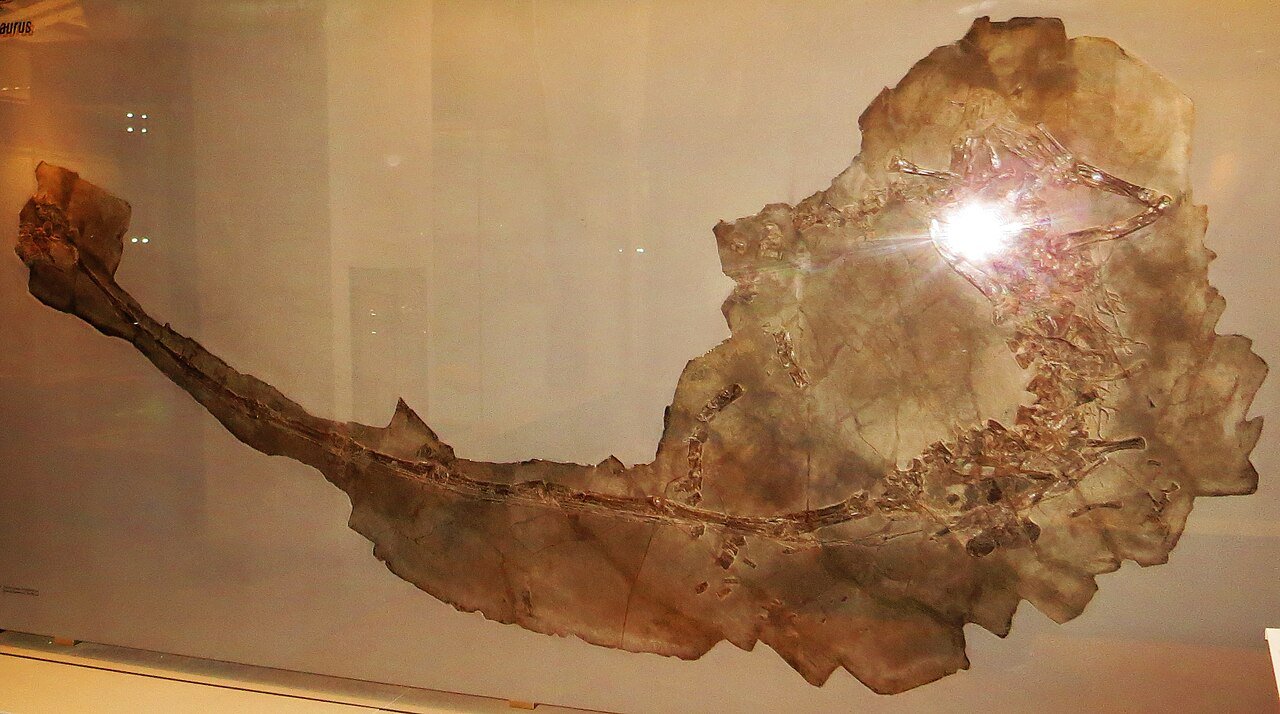
One of the strangest proportions ever found — strange enough to fuel a decades-long argument between researchers. A reptile from about 242 million years ago, fossils found across Europe and the Middle East, reaching roughly 19 ft in its largest form.
- The neck: nearly half its entire length — about 10 ft of neck on a small body and short tail — built from just 13 vertebrae. Long, but stiff: it couldn’t sweep freely, and pointed mostly forward.
- The debate: a rigid neck that long is hard to explain on land, where it would be unwieldy. Held horizontally just below the water surface, it makes far more sense as a fish-ambush tool.
- The 2020 resolution: micro-CT scanning of the teeth found two distinct tooth types. Large specimens had simple fangs for catching fish and squid; smaller specimens had multi-cusped teeth suited to shelled animals like shrimp and crabs.
- The twist: what everyone assumed were young and adult forms of one animal were actually two separate species living completely different lifestyles.
| Discovery | Age | Standout stat |
|---|---|---|
| Tully Monster | 307 million years ago | Unclassifiable after 60+ years |
| Gigantopithecus | Until ~250–300 thousand years ago | 10 ft tall, ~660 lb, from a shop molar |
| Kelenken | 15 million years ago | Largest bird skull ever, ~37 mph |
| Helicoprion | Permian | Jaw-saw, 25–32 ft, never shed a tooth |
| Arthropleura | 300 million years ago | 8 ft land invertebrate, ATV-track footprints |
| Jaekelopterus | 390 million years ago | Largest arthropod, 8 ft from one claw |
| Dunkleosteus | 382 million years ago | 6,000–7,500 N bite, self-sharpening blades |
| Titanoboa | 58–60 million years ago | 42 ft, over 2,200 lb |
| Hallucigenia | 508 million years ago | Reconstructed upside down for decades |
| Megalania | Until ~40–50 thousand years ago | Up to 23 ft, possibly venomous |
| Saccorhytus | 540 million years ago | 1 mm across, apparently no anus |
| Tanystropheus | 242 million years ago | 10 ft neck, 13 stiff vertebrae |
What Comes Next?
What ties these twelve together is that every one of them arrived incomplete: a spiral with no skeleton, a bag with no rear, jawbones with no animal. The disturbing part isn’t just the creatures — it’s how much of the record is molts, fragments, single teeth and crushed concretions, and how much of the story gets rebuilt decades later from a box of pieces somebody almost threw away.
The pattern in the corrections is also worth noticing. Hallucigenia went from walking on its own armor to walking on its legs. Saccorhytus slid from our direct lineage toward the arthropods. Tanystropheus’ two “growth stages” turned out to be two animals. The names and numbers change; the fossils barely move. What changes is the question being asked of them.
Image Credits
- Helicoprion sp. (fossil shark tooth whorl) (Phosphoria Formation, mid-Permian; Idaho, USA) 6 (34254480436) by James St. John — CC BY 2.0
- Tullimonstrum gregarium1 by Ghedoghedo — CC BY-SA 3.0
- Gigantopithecus blacki by Ghedoghedo — CC BY-SA 3.0
- Esqueleto Kelenken guillermoi by Rjcastillo — CC BY-SA 4.0
- Helicoprion as chimeroid by Nobu Tamura — CC BY-SA 4.0
- Arthropleura Reconstruction by Prehistorica CM — CC BY 4.0
- Jaekelopterus rhenaniae reconstruction by Nobu Tamura — CC BY-SA 4.0
- Dunkleosteus closed mouth by LiterallyMiguel — CC BY 4.0
- Titanoboa vertebrae by Rextron — CC BY-SA 4.0
- 20210000 Hallucigenia diagrammatic reconstruction by Junnn11 — CC BY-SA 4.0
- Megalania (Varanus priscus) by ARC CoE CABAH — CC BY-SA 4.0
- Saccorhytus by PaleoEquii — CC BY 4.0
- Tanystropheus longobardicus 54789 by Ghedoghedo — CC BY-SA 4.0